
Last updated on September 17, 2026
Many courses depend on the ability to share accurate and accessible equations, however, mathematical equations can be difficult to render in a virtual environment. Fortunately, Canvas has integrated MathJax and LaTeX (pronounced latech) into the text editor to make this process easy. MathJax is the JavaScript library that Canvas uses behind the scenes to actually render LaTeX code into properly formatted math notation (superscripts, fractions, square roots, etc.) in the browser. This also has the added benefit of making equations more accessible to students using screen readers than those typed with basic keyboard characters.
Canvas also has a built-in Equation Editor that allows you to click symbol/template buttons and enter values inside placeholder boxes to easily render accessible equations. Both the Equation Editor and direct LaTeX code work with MathJax in Canvas to create equations that are screen reader accessible and can be edited later, unlike a static image of an equation.
Directions
[Length 3:28, CC Available]
- Log in to your Canvas Account.
- Select the Course you’d like to work in.
- Locate the Item (page, assignment, discussion) where you would like to put an equation.
- Note: To add a formula as a question in a Canvas Quiz, view our tutorial, Use Formula Quiz Questions in Canvas.
- Click the name of the item you wish to edit.
- Click Edit at the top right of the screen.
- Enter any text that will come before the equation.
- Click into the Rich Content Editor where you want the equation.
Use LaTeX to Display Equations
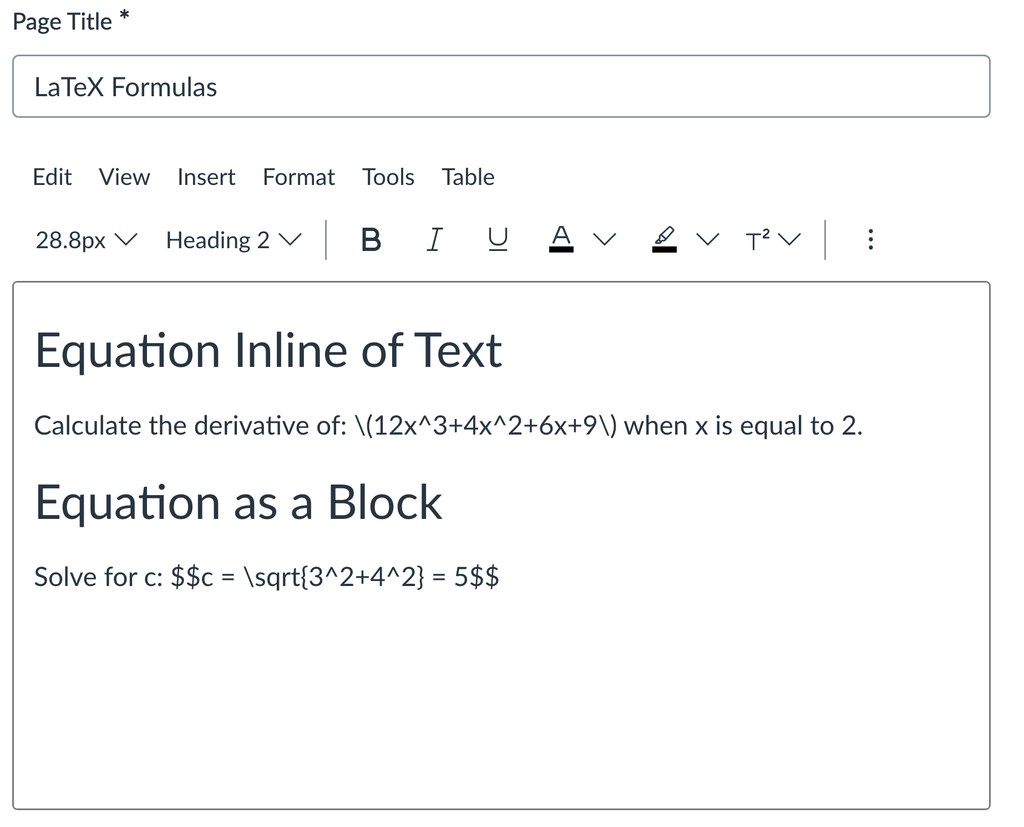
- Type the appropriate Delimiter to signal that the equation should be rendered in LaTeX.
- Type a backslash and parentheses \( and \) before and after the equation for equations that are meant to be displayed inline with text.
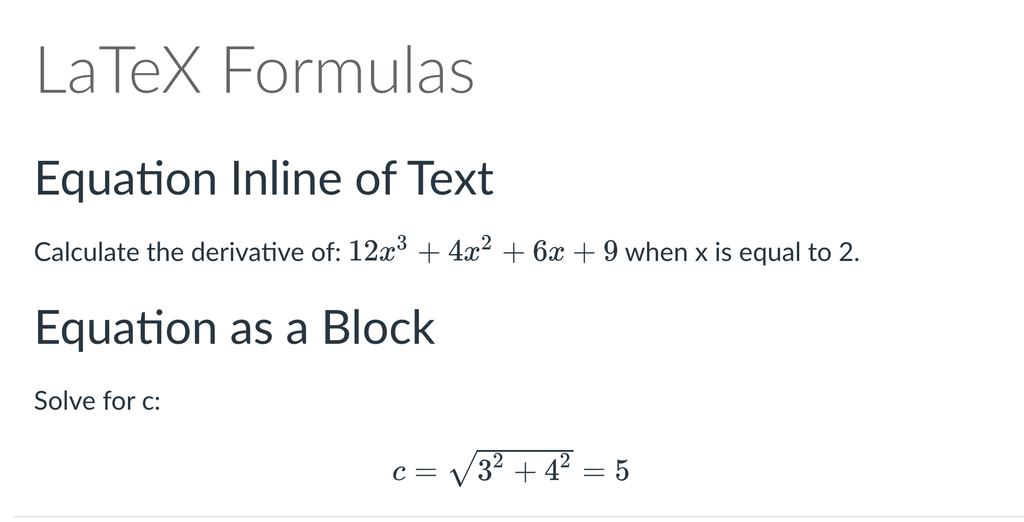
- Example: \(12x^3+4x^2+6x+9\)
- Typetwo dollar signs$$ before and after the equation for equations that are meant to be displayed in separate blocks.
- Example: $$c = \sqrt{3^2+4^2} = 5$$
- Type a backslash and parentheses \( and \) before and after the equation for equations that are meant to be displayed inline with text.
- Type the Equation using LaTeX commands to create symbols between the delimiters.
- Ex: \(2+2=4\) for inline text or $$2+2=4$$ for block text
- View this List of LaTeX Mathematical Symbols for guidance on how to create different symbols using LaTeX commands, or view the Equation Editor section below for steps on using the built-in tool for creating equations in the RCE.
- Enter any text that you want to come after the equation.
- Click Save at the bottom right of the page.
- Check that the equation is being displayed correctly.
Use the Equation Editor to Format Equations
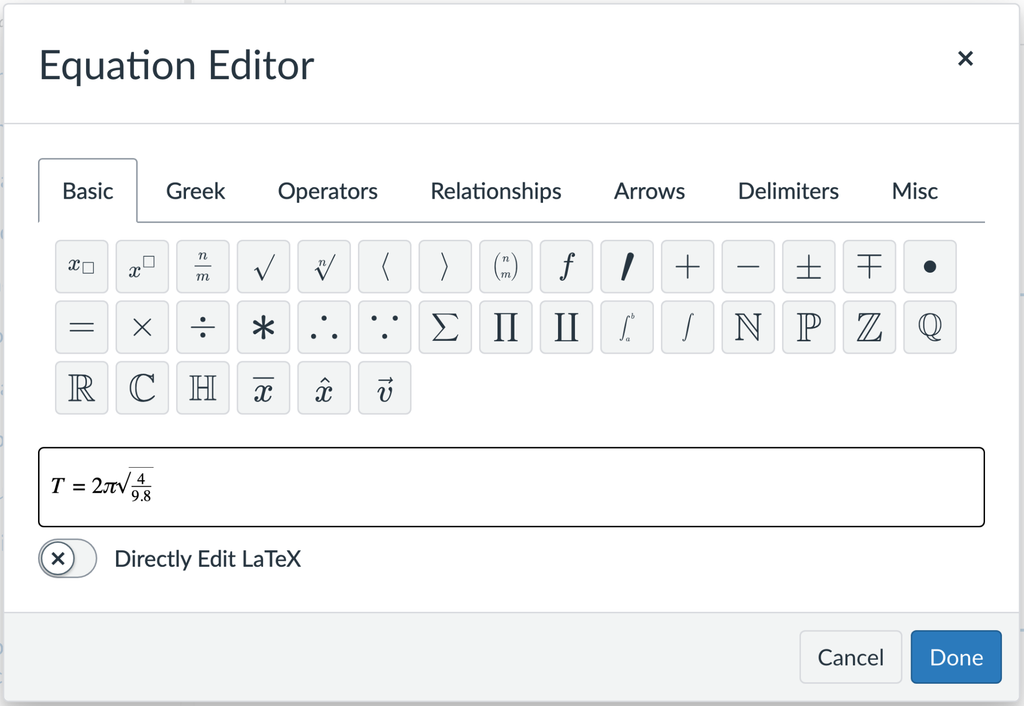
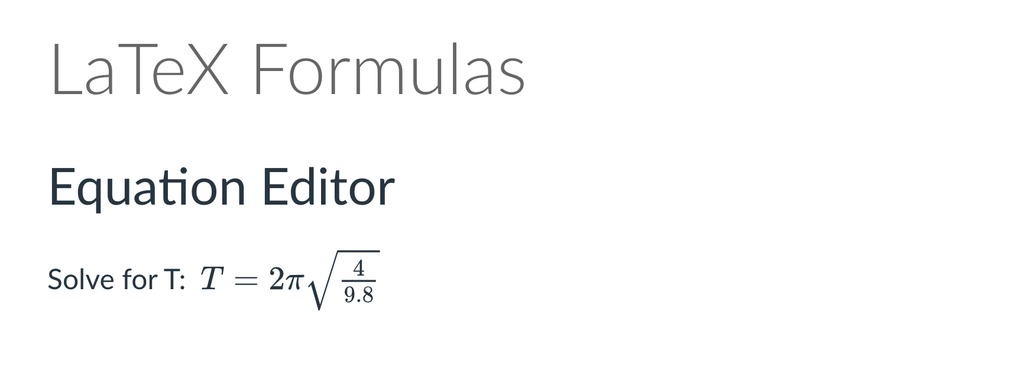
For more complex equations, you can use the Equation Editor tool built into the RCE to help format it. The Equation Editor will render the equation as an accessible image that is displayed inline with text.
- Click the Equation Editor Icon (square root of x) from the toolbar above the RCE.
- Note: If you do not see the Equation Editor Icon, click the three dots at the far right of the RCE toolbar.
- Type any variables or numbers directly into the equation textbox.
- Select a symbol category from the tabs at the top of the Equation Editor pop-up.
- Click a symbol to insert it into the equation box below the tabs.
- Click into any placeholder boxes that appear and enternumbers or variables into them.
- Note: Press the right arrow key on your keyboard to exit the placeholder box.
- Click Done at the bottom right of the Equation Editor once your equation is complete.
- Enter any text that you want to come after the equation.
- Click Save at the bottom right of the page.
- Check that the equation is being displayed correctly.
Have Questions?
Need additional support on this or other teaching and learning topics? Please visit us for drop-in support or try one of our self-help tutorials.
Ready to take your teaching to the next level? Opt into our Connections with CTLD newsletter!