
Last updated on September 9, 2026
By: Jennifer Whitton-Trujillo, Ben Cornish, Alex McDaniel
The economics of social justice involves several sensitive topics that relate differently to each student’s experiences, perspectives, and questions. So, how do you design an online economics course that asks students to examine complex issues of race and social justice while keeping economic analysis at the center of that learning experience?
That was one of the central design questions behind ECO 3600: Economics for Social Justice, developed in collaboration with Dr. Christina Huber. The course asks students to investigate and analyze racial disparities across areas such as labor markets, housing, wealth, health, and the criminal justice system using economic theories, models, and evidence.
To do this, Dr. Huber encouraged an engaged, hands-on approach to teach students the economic models and how to examine evidence, test possible explanations, identify what those explanations may leave unanswered, and evaluate potential policy responses. The primary tools supporting this course included topic-focused media, active and interactive learning, and scaffolded application and analysis.
Video Spotlight
[Length 6:57, CC Available]
Showcase Examples
Short, Purpose-Built Media
Media plays an important role in this course because having a strong instructor presence helps guide students through challenging information and conversations about the role that social justice plays in economics. By seeing and hearing from Dr. Huber through video, students are supported with a more personal connection as they learn to distinguish between evidence and assumptions and raise questions that encourage critical thinking.
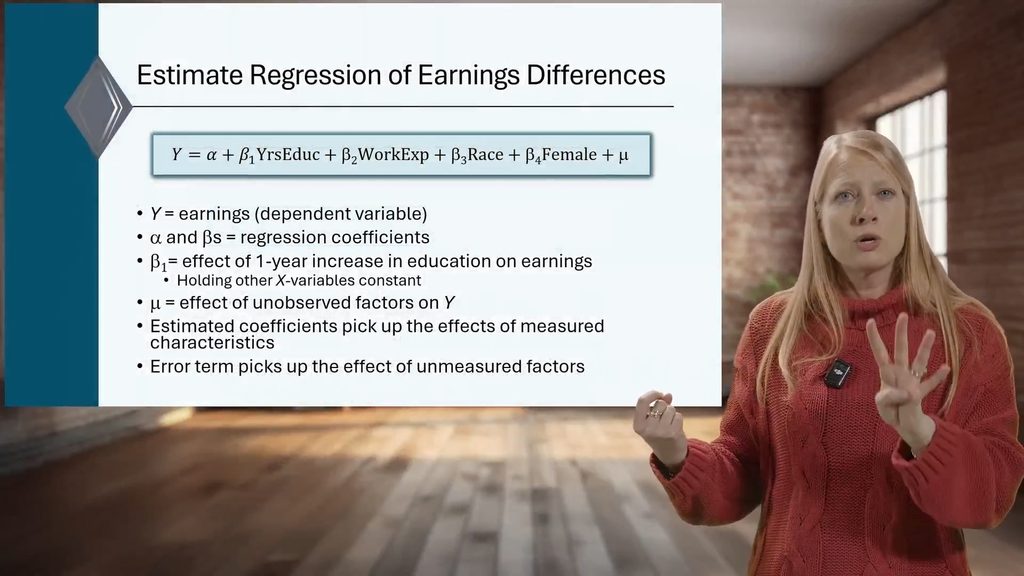
Working with Dr. Huber, CTLD developed 53 short instructional videos designed to supplement, introduce, and expand on the rest of the course materials. The videos draw on Richard Mayer’s Principles of Multimedia Learning. Instead of presenting long lectures covering many interconnected ideas at once, complex information is divided into shorter, topic-focused segments. Foundational concepts appear before more advanced applications, and accessible visuals reinforce the instructor’s explanations. The videos focus on introducing economic concepts using real-world context, supporting principles of andragogy by giving new concepts relevance to students’ lives and careers.
This approach helps students manage the cognitive demands of learning unfamiliar economic concepts while also considering some of the hard questions about inequality. It creates space for students to understand the analytical tools before they are expected to use those tools to interpret sensitive and consequential social issues.
Active and Interactive Learning
This course uses experiential and active learning principles to help students engage and think critically about the concepts they are learning. Active learning techniques implemented in the course include MS Whiteboard activities for students to collaborate and discuss the impact of race throughout history on present-day economics, critical reading responses and analyses, and application-based practice problems. Students are not simply told about course concepts. They are asked to do something with what they’re learning.
This course also incorporates experiential learning to help build a bridge between economic models and the human experience. One example of this is the Human Capital Model activity. The Human Capital Model involves individuals weighing costs (e.g., tuition and foregone earnings) against potential benefits (e.g., expected future earnings) to make decisions about education.
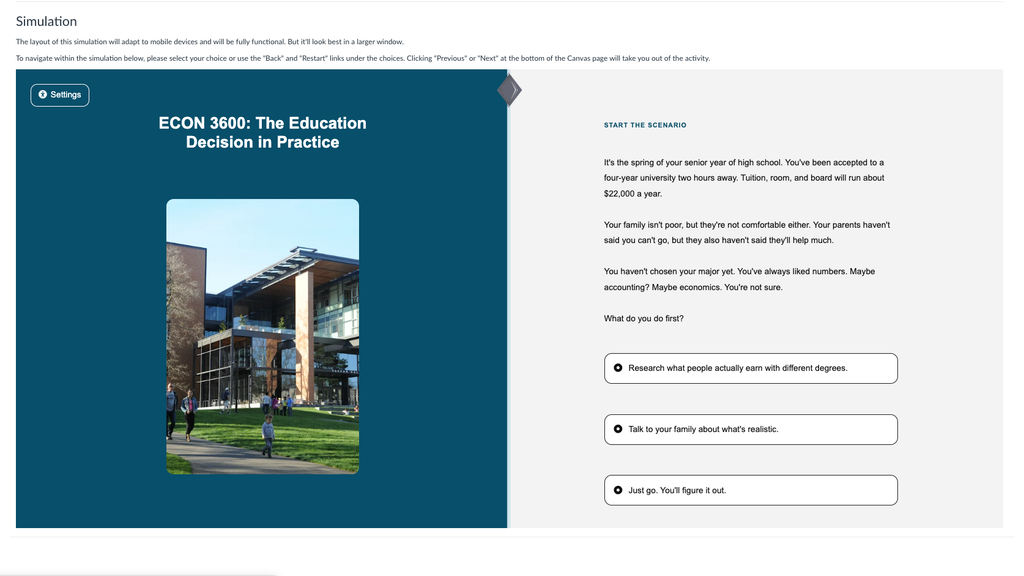
But real decisions about education are rarely made with a tidy spreadsheet and perfect information. Educational decisions are complex and involve tradeoffs.
To help students explore this complexity, the course includes an interactive branching simulation created in Twine. Through a series of simulated scenarios, students experience firsthand how economists use the Human Capital Model to conceptualize education as an investment. Students start the simulation by taking on the role of a high school senior deciding whether to enroll in college. With each new scenario they encounter, they must make decisions involving expected earnings, family responsibilities, access to mentors, debt tolerance, and uncertainty about the future. Their choices determine what happens next.
There is no single correct path. As they progress through the simulation, students make tradeoffs, observe their consequences, reflect on the experience, and then use economic theory to interpret what happened.
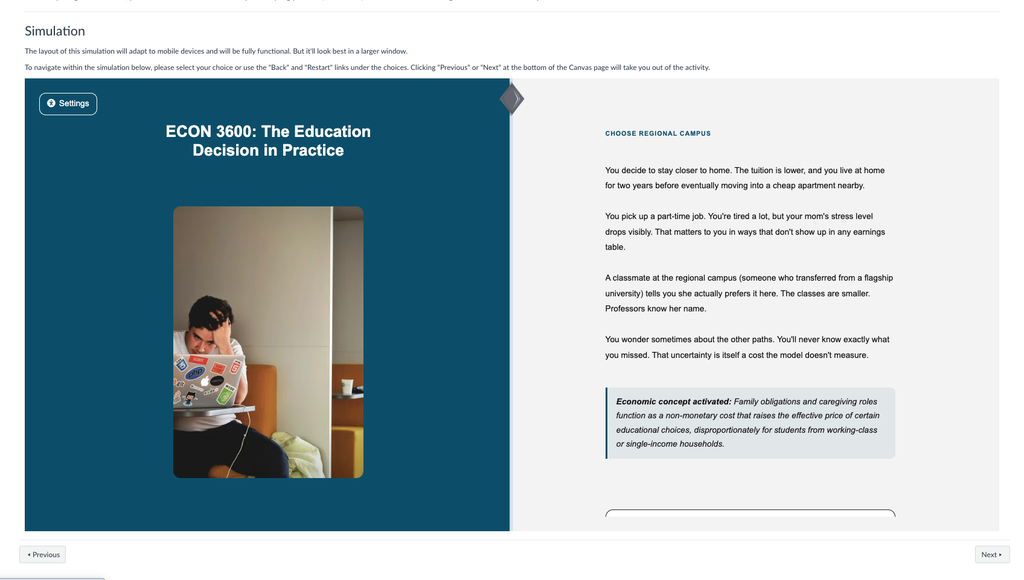
After completing the simulation, students participate in a reflective discussion in which they use the Human Capital Model to analyze an educational decision from their own experience or one they have observed. The sequence moves students from concept to experience, to reflection and analysis.
Scaffolding Toward Independent Analysis
The final assignment in this course requires students to complete a full analytical paper examining racial disparities in a specific domain of economic life. This assignment is scaffolded into the following four parts that culminate in a summative final project:
- In Stage 1, students choose an area of racial economic inequality and establish the disparity using credible evidence.
- In Stage 2, they select an economic theory that could help explain the disparity, apply that theory to the evidence, and critically consider what the theory may not fully explain.
- In Stage 3, students shift from explaining the problem to evaluating a potential response. They identify a policy intervention, examine evidence of its effectiveness, and consider its limitations.
- Finally, in Stage 4, students bring those pieces together into a complete research paper, integrating evidence, economic theory, critical analysis, and policy evaluation.
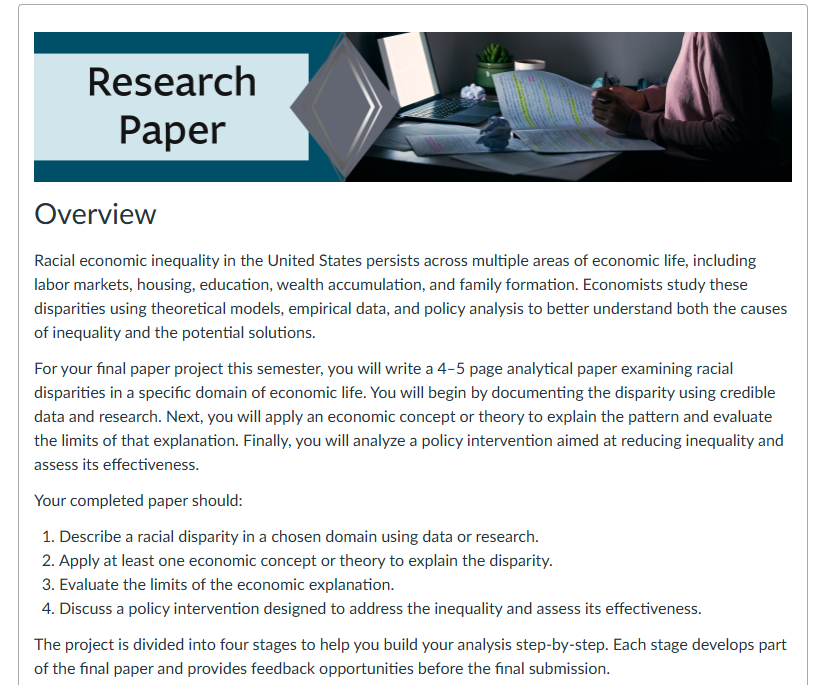
Scaffolding the large project into smaller pieces results in a more manageable research assignment, but it also provides students with the opportunity to practice and receive feedback on each step along the way. As their analytical skills develop, the course gradually removes some of that support, allowing them to conduct the final analysis for themselves.
The course uses similar scaffolding within individual modules. Application-based activities and assignments give students opportunities to practice the kinds of analysis they will later be expected to perform on exams and larger assessments.
Conclusion
ECO 3600 is an example of how thoughtful course design can support students as they learn economics while also examining complex questions about race and social justice. Through purpose-built media, active and experiential learning, and intentional scaffolding, students build the knowledge and analytical skills needed to move from learning economic concepts to applying, questioning, and evaluating them in real-world contexts.
Partnering for Continuous Improvement in Teaching and Learning
A significant factor in the success of this and similar projects is the support and funding from the Office of Online Learning (OOL), which has been instrumental in enhancing the quality of our online educational endeavors. OOL’s support and contributions have empowered faculty members to innovate and create a more enriching educational environment for all. Please visit the Office of Online Learning for more information about all that they are doing to help MSU Denver faculty members and students.
Want to get involved?
One way to find help with implementing student supports in your course is the CTLD Course Development Cycle. This is an intensive, but rewarding, process where an instructional designer will work with you over the course of several months to identify course objectives, develop learning activities, create a user-friendly course, record high-quality multimedia content, and much more.
For more information on the CTLD Development Cycle, as well as how to apply to join, please see our CTLD Course Development Cycle spotlight.
Have questions?
Want help on this or other teaching and learning topics? Please visit us for drop-in support or try one of our self-help tutorials.