
Last updated on September 9, 2026
By: Ciara Rupert, Marit Smith, Knox Mallette, Tim Wright, and Alex McDaniel
In the CTLD Course Development Cycle, MSU Denver instructors work with the instructional design team to improve their existing or new courses. Instructors identify course objectives, develop learning activities, create a user-friendly course, record high-quality multimedia content, and much more.
As part of the Spring 2026 development cycle, Environmental Science instructors Dr. Sarah Schliemann and Dr. Sara Jackson Shumate worked with the CTLD Instructional Design Team to create an online version of ENV 3350, Climate Change Solutions. Dr. Schliemann, Dr. Shumate, and the CTLD heavily emphasized multimedia and collaboration, and created a scaffolded learning experience in this course.
Video Spotlight
[Length 7:09, CC Available]
Showcase Examples
About the Instructors
Dr. Sarah Schliemann grew up in Denver and spent her childhood exploring the natural world in the city and the mountains. Her love of the natural world led her to the University of Colorado, Boulder where she earned a bachelor’s degree in biology. She continued her education with a master’s degree in Environmental Science at the University of California, Santa Barbara, and a PhD in Forest and Wildlife Ecology from the University of Wisconsin, Madison. Her research focuses on climate change and the role of mountain soils in carbon storage.
Dr. Sara Jackson Shumate is a human geographer and has taught a variety of geography, sustainability, and, from time to time GIS (Geographic Information Systems) and environmental science courses here at MSU Denver since 2015. She is currently the Director of the Center for Individualized Learning. Dr. Shumate has taught several topics such as Indigenous Territories and Spatial Justice, Economic Geography, and Planning for Climate Change. Her research has focused on how people perceive infrastructure, with a particular interest and focus on mining-related infrastructure in Mongolia.

Instructor Created Multimedia
To bring climate change solutions into a relevant, real-world context, Dr. Schliemann and Dr. Shumate partnered with faculty members, the Auraria Sustainable Campus Program (ASCP), and the CTLD media team to develop original multimedia for the course.Together, they produced a collection of lectures, interviews, and on-location recordings that connect course concepts with the people, initiatives, and sustainability efforts taking place on the Auraria Campus.
Dr. Schliemann and Dr. Shumate identified opportunities for on-location filming, coordinated recording sessions with campus partners, and worked closely with ASCP and the CTLD media team to translate these experiences into purposeful instructional media.

These multimedia experiences also support principles of Universal Design for Learning (UDL) by presenting course concepts through multiple forms of representation. Lectures provide structured explanations of key ideas, interviews introduce students to the perspectives and expertise of others, and on-location recordings situate concepts within authentic environments.
An Interdisciplinary Approach to Climate Change Solutions
ENV 3350: Climate Change Solutions grew from Dr. Sarah Schliemann and Dr. Sara Jackson Shumate’s shared passion for moving climate education beyond a focus on problems and toward meaningful action. Their complementary expertise brings an interdisciplinary perspective to the course: Dr. Schliemann contributes a natural and environmental science background, while Dr. Shumate brings expertise in human geography, sustainability, planning, infrastructure, and spatial justice. Together, they encourage students to consider climate solutions in relation to both environmental systems and the people, communities, and places affected by them.
Dr. Schliemann and Dr. Shumate jointly developed content, identified meaningful and accessible resources, and created and adapted readings using Open Educational Resources (OER). Strong instructor presence is maintained through lectures, module overview videos, interviews, and on-location recordings, giving students multiple ways to engage with course concepts and the instructors’ perspectives.

Connecting Course Content to the Community
A centerpiece of ENV 3350 is a multimedia project that takes learning beyond the classroom and into students’ communities. Students investigate a locally implemented climate change solution, conduct background research, visit a relevant site, and interview an expert before sharing what they learn through a video or podcast. This authentic learning experience encourages students to connect course concepts to real-world climate action while engaging with the expertise and perspectives of professionals working in their communities.
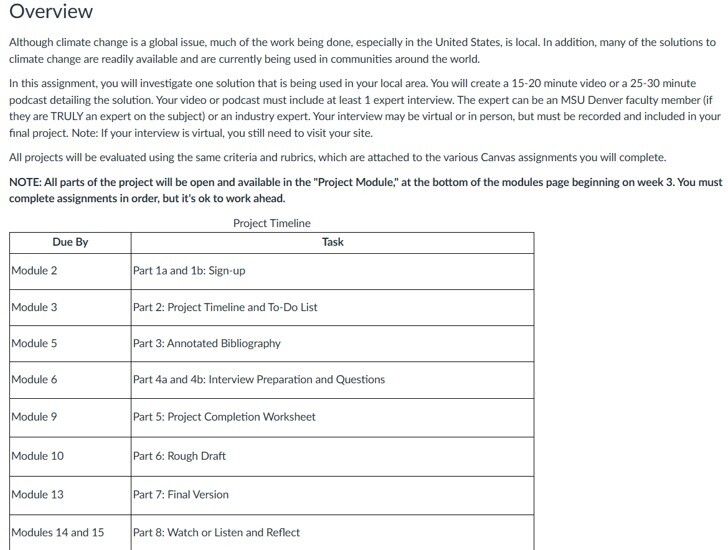
Dr. Schliemann and Dr. Shumate scaffolded the project across the course through manageable milestones, including project planning, research, interview preparation, and a rough draft. This structure supports students as they build toward a complex final product while still providing meaningful choices in the solution they investigate and how they communicate their learning. By combining scaffolding, learner choice, and community engagement, the project supports UDL principles while helping students develop skills and connections that prepare them to participate in climate change solutions beyond the course.
Conclusion
ENV 3350: Climate Change Solutions demonstrates how thoughtful course design can transform a complex and often overwhelming topic into an engaging, accessible, and action-oriented learning experience. Through Dr. Schliemann and Dr. Shumate’s interdisciplinary partnership, intentionally designed multimedia, accessible and relevant course materials, and a scaffolded community-based project, students encounter climate solutions from multiple perspectives and connect their learning to the world around them. By incorporating UDL, authentic learning, and strong instructor presence throughout the course, ENV 3350 empowers students not only to understand the challenges of climate change, but also to recognize the possibilities for meaningful action and their own potential role in creating solutions.
Partnering for Continuous Improvement in Teaching and Learning
A significant factor in the success of this and similar projects is the support and funding from the Office of Online Learning (OOL), which has been instrumental in enhancing the quality of our online educational endeavors. OOL’s support and contributions have empowered faculty members to innovate and create a more enriching educational environment for all. Please visit the Office of Online Learning for more information about all that they are doing to help MSU Denver faculty members and students.
Want to get involved?
One way to find help with implementing student supports in your course is the CTLD Course Development Cycle. This is an intensive, but rewarding, process where an instructional designer will work with you over the course of several months to identify course objectives, develop learning activities, create a user-friendly course, record high-quality multimedia content, and much more.
For more information on the CTLD Development Cycle, as well as how to apply to join, please see our CTLD Course Development Cycle spotlight.
Have questions?
Want help on this or other teaching and learning topics? Please visit us for drop-in support or try one of our self-help tutorials.