
Last updated on September 4, 2026
Generative Artificial Intelligence (Gen AI) has become increasingly prominent in education, often raising concerns about academic integrity and the misuse of Gen AI tools. In turn, when used appropriately, Gen AI can help both faculty and students with content creation and efficiency.
As the AI industry grows, integrating it into courses, whether directly or through policies, is becoming more and more important. Teaching students to use Gen AI responsibly rather than attempting to prohibit its use completely helps reduce violations of course AI policies and builds necessary skills for the current workforce.
In this spotlight, we will cover best practices for integrating AI into your course, creating assessments to mitigate cheating, and educating students on the responsible use of Gen AI. Additional resources are linked throughout that provide more in-depth information or examples.
Best Practices
What Are the Drawbacks of Integrating Generative AI in Your Course?
Before diving into ways that Gen AI can be beneficial for faculty and students, it is important to understand why and when Gen AI could be harmful.
- Gen AI can have hallucinations or biases and provide incorrect information, so it is important to always check its work yourself.
- If AI is used too frequently to generate feedback on course content, it can diminish the human element of teaching and lead to a less personalized learning experience.
- Overuse of Gen AI can reduce opportunities for students to develop essential research, problem-solving, and critical thinking skills.
- There are many privacy concerns regarding Gen AI tools, so it is important to never input any identifiable information, such as names, grades, IEP details, etc., into a Gen AI tool.
How Should You Communicate Generative AI Policies and Expectations to Students?
- Provide an overall AI-use policy in your course syllabus.
- The MSU Denver resource, AI Course Policies and Syllabus Language, provides specific examples of different Gen AI policies you could use in your course.
- This NKU AI Acceptable Use Statement Generator utilizes Gen AI to create a customized AI policy for your course.
- Include explicit, accessible statements in your course informing students of the expectations and boundaries surrounding the use of artificial intelligence tools in coursework.
- AI policies should specify which AI tools, if any, are permitted for use in assignments and clearly outline consequences for unauthorized AI use.
- Communicate activity-specific AI use policies in the directions of each activity (assignments, discussions, quizzes, etc.) to allow for differentiated policies based on assignment type and importance.
- Provide clear guidance on how students should disclose Gen AI use in your course for assignments where it is allowed.
For some ideas regarding handling students’ AI use in academic settings, see our spotlight Start A Conversation about Generative AI.
How Should Faculty Use and Disclose Artificial Intelligence Throughout the Course?
If you used Gen AI to help with course creation, it is important to provide transparent communication to students regarding any role artificial intelligence plays in the development of course content, assessments, supporting materials, and communication.
- Provide an overall disclosure statement on the course homepage or syllabus detailing where and how AI was used in course creation.
- Label individual materials generated or assisted by AI.
- An example of an instructor disclosure statement:
- This page was developed with assistance from GenerativeAI (ChatGPT) to help brainstorm and organize ideas. All final content, decisions, and edits were made by the instructor.
- An example of an instructor disclosure statement:
- Explain the purpose and scope of AI use in course design.
- Communicate when and how AI is used when communicating with students, such as helping generate Canvas messages or emails.
- Disclose where and how AI is used to evaluate student work.
Let’s Walk Through it Together
[Length 12:00, CC Available]
How Faculty can use Generative AI in their Course
Gen AI can assist with generating learning materials, creating student examples, and streamlining workflows. It is important to utilize Gen AI cautiously, making sure to focus on where it can help enhance your course, rather than replacing the human element.
Gen AI can be especially helpful with:
- Streamlining routine or administrative tasks, such as writing routine announcements and drafting common feedback comments.
- Brainstorming, helping draft, or providing feedback on course content such as lessons or student examples.
- Make sure to check, revise, and disclose any written material generated by Gen AI.
- Generating HTML code to use in the RCE to create more inclusive or engaging learning experiences in Canvas.
- See Use HTML to Edit Content in Canvas for more information.
- Converting course materials into more accessible, well-structured formats that improve usability for all users.
- Making complex or abstract ideas more understandable by putting them into simpler language.
Check out these CTLD spotlights for more in-depth examples of how you can use AI in your course:
- Consider Teaching and Learning Issues with AI
- Effective AI Prompt Generation
- Using Generative AI as a Faculty Tool
- Get Started Using Generative AI in Your Course
Create Authentic Assessments in the Age of Generative AI
One of the biggest concerns when it comes to Gen AI is how students can use it to cheat on assignments and exams. While there is no way to completely eliminate this, there are strategies you can use to promote responsible use and build necessary skills.
- Avoid multiple-choice exams for online summative assessments where Gen AI tools can quickly generate the correct answers for students.
- Connect assignments to real-world applications. Have students apply the content to local contexts, or create scenario-based problems where students have to explain how they would approach the problem using what they learned.
- Focus on the process over the end product for written or project-based assignments.
- This might include breaking the assignment into chunks turned in over time, such as: Outline, annotated bibliography, draft, peer reviews, and final product.
- Use a proctoring service, like the MSU Testing Center or ProctorU, for important exams to help reduce the possibility of Gen AI use.
- Note: If you are teaching an online course, talk with your department chair about the possibility/limitations of using in-person proctoring services, as there may be some restrictions based on the mode of instruction.
- See our spotlight, Proctor Online Assessments, for more information on the different proctoring options that MSU Denver provides.
- Avoid reliance on AI detectors for grading. Surveys show that 80% of respondents believe AI detectors are correct only “sometimes”, emphasizing that authentic assessments that prioritize complex tasks are more effective for meaning academic integrity.
- Quality Matters. (2025). AI integration for course design recommendations. AI Integration for Course Design Recommendations
Refer to our Spotlight, Consider Academic Integrity with AI, for more ideas and specific examples.
Increase Student Generative AI Literacy within your Course
While policies help set the expectations for your course, it is also important to recognize that many students will use Gen AI no matter what. Rather than using strict No AI policies that can often result in students hiding their AI use, focus on increasing student literacy in how to use Generative AI responsibly.
- Studies show that 51% of students would continue to use Gen AI tools, even if they were prohibited by their instructor, highlighting the need for integrating responsible use of AI in your course.
- Quality Matters. (2025). AI integration for course design recommendations. AI Integration for Course Design Recommendations
The CTLD has developed a Student AI Literacy Module that you can import directly into your course to help prepare and teach students responsible use of Gen AI. To learn more about the module, see our article Teaching AI Literacy: Preparing Students for Responsible Use.
For a step-by-step guide on how to import the module into your Canvas Course, see our tutorial Import the CTLD Student AI Literacy Module into a Canvas Course
Prepare Students for an AI-Influenced Life and Workforce
AI is being integrated into almost every facet of our lives, with personal and professional implications. From search queries including Gen AI results, Gen AI-infused content-creating tools, and the fact that more and more companies are beginning to utilize AI in their day-to-day operations. Because of this, it can be beneficial to provide students with practice in how they might be expected to use Gen AI in their future lives and careers.
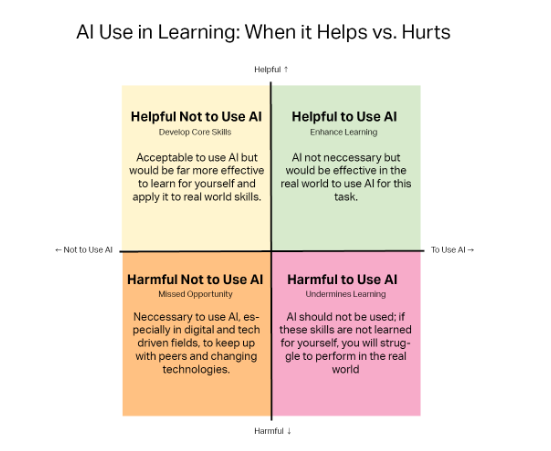
- Use the AI Impact Quadrant Model to help students determine whether Gen AI is helpful or harmful in a specific situation.
- The AI Literacy Module, linked above, has more information about the Quadrant Model.
- Create assignments where students are expected to evaluate an AI-generated source by identifying inaccuracies, comparing it to course readings, or revising to improve it.
- Hypothes.is has an AI Literacy pack where students annotate AI-generated articles to find fabricated citations, check facts, and build verification skills.
- Have students use a Gen AI tool to solve a real-world problem applicable to their field of study, such as analyzing datasets, generating code, or transcribing videos.
- Create a course-specific AI chatbot trained on uploaded materials that allows students to explore concepts, ask target questions, and engage in interactive simulations such as interviewing historical figures.
- Ask students to record or copy/paste their conversations with Gen AI and reflect on their experiences.
Refer to our Spotlight, Using Generative AI to Enhance Student Learning, for more ways you can create assignments that encourage critical thinking with Gen AI.
Concluding Thoughts
Generative AI has been at the forefront of many conversations in education. While it raises valid concerns about academic integrity, it can also be a valuable tool for both students and faculty. Because of this, integrating Gen AI into courses and teaching responsible use has become essential for preparing students to navigate AI in academic and professional contexts.
Have questions?
Want to talk about how you can implement any of these ideas into your course, discuss any specific issues or questions regarding Gen AI, or need support on other teaching and learning topics? Please visit us for drop-in support or try one of our self-help tutorials.
Ready to take your teaching to the next level? Opt into our Connections with CTLD newsletter!